

If you work in council finance, operations or systems, you are probably planning around these dates now. They decide when you migrate systems, when new processes need to be ready and which services must keep running under the existing councils. This guide sets out each stage in order, so you can see where your council sits and what comes next. PaySuite helps local authorities prepare for this change.
In this guide:
What is local government reorganisation (LGR)?
The government plans to replace two-tier councils, where county and district councils share responsibilities, with single-tier unitary authorities. The government announced this plan in December 2024. Each new council takes on the legal duties and powers of the councils it replaces, and it is designed to deliver services from its first day.
This is the reason councils are working to a timetable. The process touches every part of a council's operation, so the timing matters as much as the destination. For background on the wider change, see our guide to local government reorganisation.

Why understanding LGR timelines is important
The timeline sets the order of work for almost everyone involved.
- Council officers need to know when their roles, teams and reporting lines change.
- Finance directors need to know when budgets, assets and contracts transfer to the new council.
- Operational teams need to know which services continue under the existing councils until vesting day.
Knowing the dates early gives teams time to plan system migrations, design new processes and agree how data and staff move across.
The timetable has also changed since the process began. Check the current position regularly rather than planning around a single published schedule.

The key stages of local government reorganisation
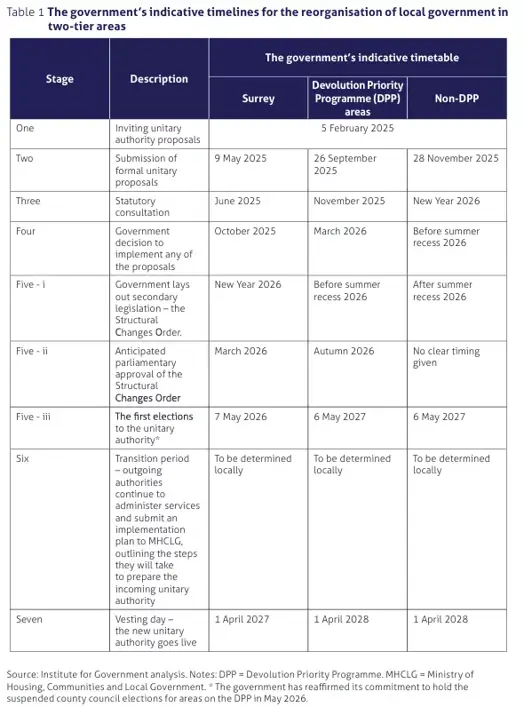
LGR runs in seven stages, from the government's invitations in February 2025 to vesting day in April 2028. That end date is the one currently scheduled, and the review announced in September 2026 may move it.
Stage 1: Inviting unitary proposals
On 5 February 2025, the government invited 21 two-tier authorities across the UK to propose new unitary councils. The invitations set out the criteria for new unitary authorities and the matters councils should weigh when preparing their proposals.
Stage 2: Submission of formal unitary proposals
Each invited council could submit one formal proposal, either on its own or jointly with others. Councils submitted interim plans by 21 March 2025 and full proposals by late November 2025. Surrey worked to an earlier timetable because its reorganisation was accelerated.
Stage 3: Statutory consultation
Before any reorganisation goes ahead, the Secretary of State must legally consult the affected councils that did not submit the proposal, along with other appropriate stakeholders. Public consultation on the proposals ran from 5 February to 26 March 2026 in the areas we reviewed.
Stage 4: Decision to implement a proposal
Once consultation closes, ministers decide which proposal, if any, to implement, with or without modification. This decision is subject to Parliamentary approval. The government published decisions in March and July 2026. Some areas, including Cambridgeshire and Peterborough and West Sussex, have had their decisions delayed.
Stage 5: Making secondary legislation
Once a decision is made, the department prepares the legislation for Parliamentary approval. This stage has three parts.
Stage 5 i: The Order
The Order sets the arrangements for the first elections to the new council, the number of councillors, and the functions the new council holds during the transition period. It also gives powers to the executive or joint committee that oversees the transition.
Stage 5 ii: Elections
Elections to the new unitary councils take place. The first elections are expected in May 2027.
Stage 5 iii: Transition period arrangements
The Structural Changes Order (SCO) sets the governance arrangements for the new unitary councils during the transition period. Councils expect the SCO to be laid in late 2026.
Stage 6: Transition period
Once the SCO is made, existing councils keep delivering services and carry on their statutory duties until vesting day. During this period they prepare to transfer assets, functions and staff. Where shadow authorities are elected, they prepare the new council but do not deliver services.
Stage 7: New unitary authority goes live
This stage is known as vesting day. On that date, the predecessor councils are dissolved and the new unitary authority takes on the legal duties and powers for local government in its area. The whole process is scheduled to finish by April 2028. East Surrey and West Surrey are an exception, with full legal powers due on 1 April 2027.
LGR stages at a glance
How should you prepare for LGR?
The timeline has seven stages, and each one changes what your council needs to have ready. Start with the stage your council is in, then work out what needs to be in place before the next one begins. Keep checking the published dates, because the review could change them.
PaySuite is helping local authorities navigate LGR.

What is Vesting Day in local government reorganisation?
Vesting day is the date when new unitary authorities go live. It is currently scheduled for 1 April 2028, and East and West Surrey are due on 1 April 2027. On that day, the predecessor councils are dissolved and the new council takes on their legal duties and powers.
How long does the LGR process typically take?
The full process from invitations to vesting day takes around three years. It began with invitations in February 2025 and is currently scheduled to finish by April 2028.
What are the biggest challenges of LGR?
Councils face tight programme timelines, pressure on budgets and funding, and the need to keep services running consistently during a period of intense change.