

If you work in a local authority and you are trying to make sense of what is happening, what comes next, and what it means for your team, this guide covers everything you need to know.
In this guide:
- What is local government reorganisation (LGR)?
- The key stages of local government reorganisation
- Challenges of local government reorganisation
- Benefits of local government reorganisation
- What are the next steps for LGR?
- FAQs
What is local government reorganisation (LGR)?
Local government reorganisation is the process of replacing England's two-tier council system, where county councils and district councils operate in parallel, with single-tier unitary authorities. Under the current two-tier model, residents often deal with two separate councils for different services: the county council for social care, education, and transport, and the district council for housing, planning, and waste collection. LGR removes that split.
The reorganisation of local government is being driven by the government's English Devolution White Paper, published in December 2024. It applies to the 21 remaining two-tier areas in England and some neighbouring small unitary authorities. The end result will be a network of unitary authorities covering the vast majority of England, each responsible for the full range of local services under one roof.
For councils in scope, LGR means merging organisations, consolidating systems, harmonising staff terms and conditions, and delivering services without interruption throughout the transition. The unitary payment challenges alone are significant, and payments are just one piece of a much larger puzzle.

Why is LGR happening?
The core reason for the reorganisation of local government is straightforward: the two-tier system is inefficient. Running two separate councils in the same area creates duplication, confusion for residents, and unnecessary cost. LGR aims to cut that waste, save money, and make local services clearer and easier to access. The government also sees larger unitary bodies as better placed to drive regional economic growth and engage meaningfully with devolution arrangements.
The key stages of local government reorganisation
LGR is a structured, multi-stage process. The timeline varies depending on which wave a council falls into, but the overall programme runs from February 2025 through to April 2028 for most areas. Surrey is moving on a faster timetable, with its new unitary authorities going live in April 2027.
The table below sets out the key stages and dates.
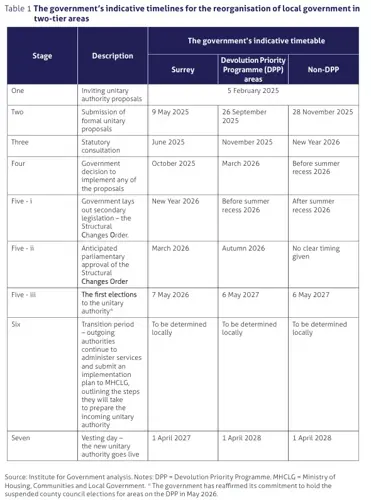
For a deeper look at how these timelines are playing out across specific areas, read our LGR timelines blog.
The DPP (Devolution Priority Programme) areas, including Greater Essex, Norfolk and Suffolk, Hampshire and the Solent, Cumbria, Cheshire and Warrington, and Sussex and Brighton, are moving on an accelerated timetable compared to the remaining 14 non-DPP areas, though both groups share the same April 2028 vesting day.

Challenges of local government reorganisation
LGR is not a simple administrative exercise. It is a structural transformation that touches every part of a council's operation. These are the challenges that consistently emerge during the process.
Tight schedules
The scale of change required within the LGR window is enormous. Councils are expected to merge organisations, consolidate systems, harmonise policies, and maintain full service delivery — all within a compressed timeframe. Some areas are better prepared than others, and the pace of the programme leaves little room for delay.
Certain functions are particularly difficult to transition quickly. Payments infrastructure is one of them: migrating payment channels, direct debit mandates, and reconciliation processes across merging councils takes time and carries compliance risk. Navigating PCI compliance during local government mergers is a challenge that many councils underestimate until they are already in the middle of it.
Funding gaps
The government has provided transition funding to support councils through LGR, but initial allocations have not always covered the full cost of implementation. Past reorganisations have shown that the actual cost of merging systems, retraining staff, and managing change programmes regularly exceeds early estimates. Councils need to plan for that gap from the outset.
Workforce pressure and uncertainty
LGR creates significant uncertainty for staff at every level. Role duplication, restructuring, and the prospect of redundancy affect morale and productivity. At the same time, the workload on those managing the transition is substantial. The combination of heavy workloads and role uncertainty makes senior recruitment difficult and retention harder, at precisely the moment when experienced people are most needed.
Temporary decline in citizen experience
During the transition period, councils are running two organisations simultaneously while building a third. Resources are stretched, systems are in flux, and staff are managing change on top of their day jobs. The risk is that the quality and consistency of services to residents dips during this period. Managing that risk requires deliberate planning and clear communication, not just internally, but with the public.

Benefits of local government reorganisation
The challenges are real, but so are the long-term gains. LGR is designed to produce a more efficient, more capable, and more responsive local government system.
Cost-efficiency
Fewer councils means fewer overheads. Shared buildings, consolidated back-office functions, and unified procurement all reduce the cost of running local government. Savings that were previously absorbed by duplication can be reinvested into frontline services. Over time, the financial case for LGR is strong, though the transition costs mean the benefits take time to materialise.
Better service delivery
Unitary authorities can deliver services in a way that two-tier councils simply cannot. Residents deal with a single point of contact rather than navigating between county and district. Services that previously sat in separate organisations, social care, housing, planning, public health, can be integrated around the needs of individuals and families rather than the boundaries of institutions. For vulnerable residents in particular, that integration can make a material difference. Faster planning decisions, aligned transport and housing strategies, and joined-up health pathways all become possible when a single authority holds the full picture.
Regional devolution
Larger unitary bodies carry more weight. They are better placed to engage with combined authorities, negotiate with central government, and make the case for investment in their areas. LGR gives councils a stronger platform for regional devolution, and the ability to shape the economic and infrastructure decisions that affect their communities for decades to come.
What are the next steps for LGR?
Local government reorganisation 2026 marks a critical point in the programme. Most councils are now past the proposal stage and moving into the implementation phase, which means the hard work of actually merging organisations, systems, and services is under way.
This guide has covered what LGR is, why it is happening, the stages involved, the challenges councils face, and the benefits that come with getting it right. The common thread across all of it is that the councils that navigate LGR most successfully are the ones that plan early, prioritise the functions that are hardest to change, and get the right support in place before they need it.
Access PaySuite is helping local authorities manage the payment complexity that comes with LGR, from consolidating direct debit mandates across merging councils to ensuring payment channels are compliant and operational on day one. If you are working through an LGR transition and want to understand how we can help, read more about how we support local authorities through LGR.
How many unitary authorities currently exist in the UK?
There are currently 132 unitary councils in the UK, covering the majority of the population. The aim of local government reorganisation is to transform the remaining non-unitary councils, those still operating under the two-tier county and district model, into the same single-tier format. Once the current programme is complete, unitary authorities will cover virtually all of England.
Do local authorities have to give consent to reorganisation?
No, local authorities do not need to give formal consent to reorganisation. The process is typically initiated at the local level, with councils invited by central government to submit proposals for new unitary structures. While councils are encouraged to collaborate and develop proposals jointly, the government retains the power to proceed with reorganisation even where full local consensus has not been reached.
How will local government reorganisation affect public service delivery?
Local government reorganisation will make public service delivery more efficient over time. The removal of the two-tier system means residents will deal with a single council for all local services, rather than navigating between county and district councils for different functions. Integrated services, covering areas such as social care, housing, and public health, will be easier to coordinate and deliver consistently. The transition period carries some risk of disruption, but the long-term direction is towards simpler, more joined-up services.
What funding changes follow local government reorganisation?
The government is supporting local authorities with transition funding during the reorganisation period. Post-LGR, the overall funding picture for councils will be broadly similar to what it is today, but the way that funding is spent will be significantly more efficient. With fewer organisations, less duplication, and shared infrastructure, unitary authorities will be able to direct more resource towards frontline services rather than administrative overhead.