

Online payments now account for more than half of card spending, up from 44% in 2019. At the same time, expectations around speed, convenience and security have never been higher. Yet many organisations are still losing customers at the point of payment due to friction-filled checkout journeys with limited payment options.
The commercial impact is significant. Clunky online payment processes drive high online shopping basket abandonment and can lead to negative reviews. With 93% of consumers checking reviews before making purchasing decisions, payment experiences are increasingly shaping brand reputation.
By examining payment experience data from 160 businesses across 16 sectors, Access PaySuite’s latest Payment Experience Report reveals which sectors deliver the smoothest payment journeys, where the biggest satisfaction gaps exist, and what businesses can learn to improve customer payment performance and reputation.
Access PaySuite analysed Trustpilot data from 160 UK businesses across 16 sectors to identify where payment experience is falling short and what the businesses closing that gap are doing differently.
The report will cover
- Which sectors deliver the best customer payment experience?
- Which sectors have the worst payment experiences?
- Which sectors face the biggest gap between payment experience and customer satisfaction?
- Sectors where payment experience matters most to customers
- What payment experience challenges are businesses facing?
- How can businesses improve payment experience and customer satisfaction?
- Payment Experience Report methodology

Key findings from the Payment Experience Report 2026
- Legal firms provide the best customer payment experiences in 2026.
- Entertainment brands rank lowest for payment experience satisfaction.
- Gym and fitness brands have the largest gap between overall customer satisfaction and payment satisfaction.
- Banking customers are most likely to leave reviews about payment issues.
- Payment friction continues to impact customer satisfaction across every sector analysed.
At a time when consumers are tightening budgets, the businesses that will stand out are the ones recognising that payments are no longer just a transaction at the end of the customer journey. Our report highlights that even after getting every touchpoint right, too many businesses are still creating unnecessary friction when it comes to taking payment, and that’s often where trust can be lost.
Which UK sectors deliver the best customer payment experiences in 2026
Legal firms provide the best customer payment experience in 2026, achieving a payment satisfaction score of 3.21 out of 5, driven by a push to digitalise billing and integrate online banking to alleviate client friction.
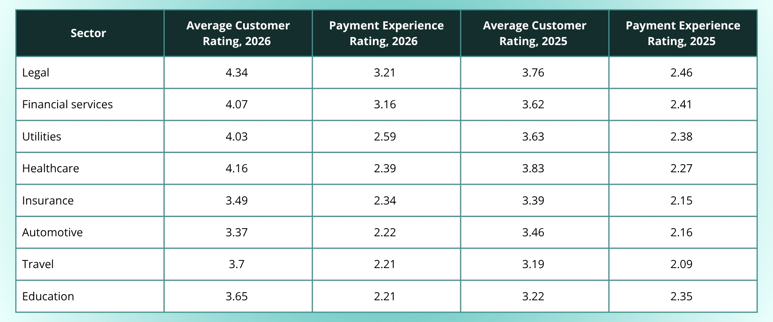
However, the overall service rating sits much higher at 4.34 – 1.13 stars ahead of payment ratings. This discrepancy indicates that while core service delivery is highly valued, there’s room for improvement in payment processes.
Financial services placed second for payment experience with a strong rating of 3.16 stars and one of the lowest discrepancies between overall rating at -0.91, a strong indicator that customers are pleased with their payment experience.
Compared with last year's findings, the legal and financial services sectors recorded the largest increase in payment satisfaction, with both sectors improving by 0.75 stars.
Payment satisfaction increased across most of the highest-performing sectors, suggesting businesses are actively modernising payment methods to improve the payment journey. Education was the notable exception, recording a decline in payment satisfaction despite maintaining a relatively strong overall ranking.

Which UK sectors have the worst customer payment experiences in 2026
The entertainment sector recorded the worst customer payment experience, with an average rating of just 1.27 out of 5 stars, signalling an urgent need to improve payment processes.
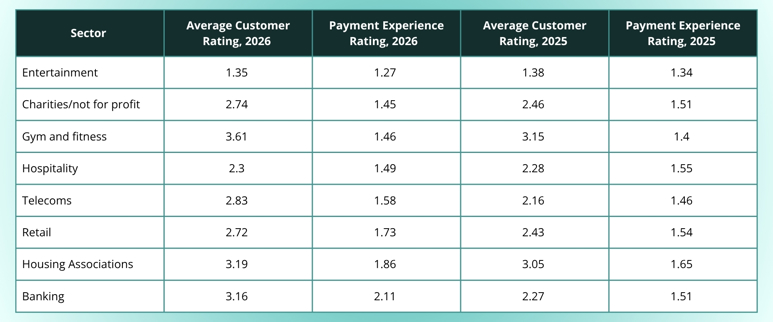
The entertainment sector's low overall TrustPilot rating of 1.35 and minimal discrepancy score (-0.08) suggest payment friction is closely linked to wider customer dissatisfaction. For subscription-based services such as streaming platforms, a smooth sign-up, billing, and cancellation experience is essential to maintaining trust and retention.
Recurring payments appear to be a particular challenge. With an estimated 10 million unwanted active subscriptions in the UK, businesses should focus on clearer billing and giving customers greater control over renewals and cancellations to reduce churn.
Charities and non-profit organisations also scored poorly, with an average payment experience rating of just 1.45 stars. Despite relying heavily on donations, the sector recorded a significant -1.29 star gap between overall customer experience and payment experience, suggesting many donors are being lost at the final stage. Simple, user-friendly payment tools such as embedded checkout forms could help remove barriers at the point of donation and encourage repeat support.
While several lower-ranked sectors improved their payment experience ratings over the past year, hospitality, entertainment and charities were among the few to move backwards, with payment expectations rising faster than businesses are adapting.

Which sectors face the biggest gap between payment experience and customer satisfaction?
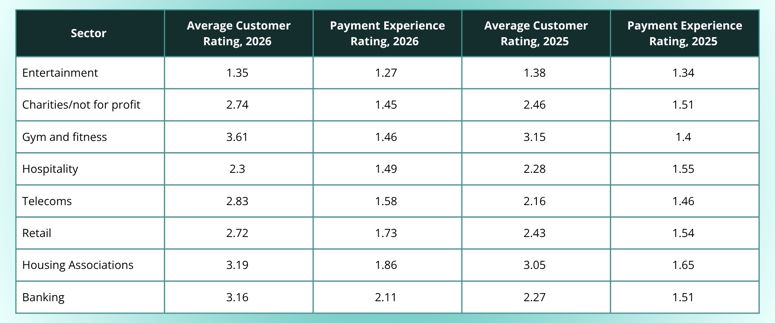
The gym and fitness sector faces the largest discrepancy between overall consumer satisfaction and payment experience, at -2.15, indicating a significant disconnect that could impact member retention and growth.
Additional research from Access PaySuite highlights the growing demand for flexible and contactless payment options in the fitness sector, meaning gyms and studios should prioritise user-friendly solutions such as mobile apps and secure online portals for class bookings and subscriptions to support long-term member retention.
Healthcare also received a large trust discrepancy score of -1.77, demonstrating a clear need for better payment experiences to improve overall sentiment. For a field that is service-oriented and can be highly charged with emotions, an easy, streamlined payment process can go a long way to alleviate stress.
While some sectors perform relatively well on payment experience, every industry analysed recorded a gap between overall customer satisfaction and payment satisfaction. This suggests customers are more likely to call-out poor payment journeys than seamless ones, making payments a common source of friction across sectors.
Sectors where payment experience matters most to customers in 2026
The banking sector receives the greatest customer attention around payment experience, with payment-related issues accounting for nearly one in ten reviews (9.27%) – more than double any other sector analysed. As payments are central banking services, consumers have a low tolerance for payment friction and are likely to scrutinise payment journeys more closely than in other sectors.
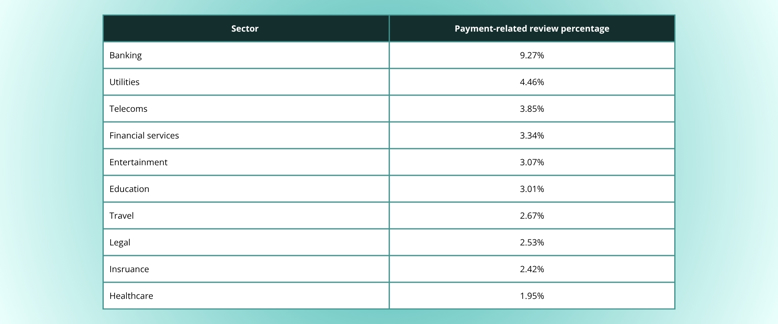
*Data correct as of May 2026
Whereas just 0.67% of housing association reviews were related to payments. This may be because the customer feedback in the sector is more heavily shaped by everyday issues such as maintenance and repairs, pushing payment experience further down the priority list, despite payment-related reviews receiving a low average experience rating of 1.86.

What payment experience challenges are businesses facing?
While the sector rankings show which industries perform best and worst, the underlying patterns are far more consistent and more revealing.
Payments are a weak link in every sector
All 16 sectors analysed scored lower on payment experience than overall customer satisfaction, highlighting a systemic issue rather than an industry-specific one. This suggests that, across industries, the payment experience is still treated as an operational process rather than a core part of the customer journey.
The gap matters as much as the score
The biggest risk isn’t low payment ratings alone; it’s the gap between overall service and payment experience. Sectors like gym and fitness, with a discrepancy of -2.15, demonstrate how even businesses with strong overall ratings can lose customer trust at the point of payment.
Recurring revenue models carry the highest risk
The sectors with the lowest payment experience scores, including entertainment, telecoms and gym and fitness, are all built on subscription or recurring billing models. This points to a common challenge: the biggest source of dissatisfaction isn't paying itself, but the complexity and inflexibility of ongoing billing.
Customers increasingly expect payment experiences to feel effortless, whether they’re paying online, in person or through automated channels.

How can businesses improve payment experience?
The data points to four areas where businesses consistently close the gap between overall satisfaction and payment experience.
1. Consolidate payment methods onto one platform.
Businesses in the top half of the index (legal, financial services and utilities) share a common characteristic: customers can pay through multiple channels without encountering disconnected systems.
Businesses using separate providers for card payments, Direct Debit and online banking often create extra reconciliation work for finance teams and a more fragmented payment experience for customers. Consolidating payments onto a single platform reduces both.
2. Fix recurring billing before it becomes a churn problem.
The gym and fitness sector's -2.15 discrepancy score points to a billing experience problem, not a marketing one. Giving customers more flexibility, such as changing payment dates or updating payment schedules without cancelling their Direct Debit, removes unnecessary friction. The same principle applies to any business that relies on recurring payments, including telecoms, insurance, utilities and subscription services.
3. Give finance teams visibility of payment performance, not just transaction records.
Payment performance data is most valuable when it feeds into operational decisions, not just month-end reports. Giving finance teams real-time visibility of failed payment rates, retry performance and payment method trends by channel makes it easier to spot problems early and take action before they impact customers.
4. Make card payments and online banking work together.
The entertainment sector’s 1.27 star payment rating highlights a challenge faced by many businesses with recurring customer relationships: payments and online account management often operate independently. Customers who can pay by card online, manage their subscription through an online banking portal, and receive clear billing communications in one place are less likely to dispute charges,
With brand loyalty at an all-time low, businesses that continue to evolve alongside those expectations and invest in modern payment technology will be the ones building loyalty and staying ahead. Those that don’t risk turning what should be the easiest part of the customer journey into the reason customers choose to go elsewhere.

Want to close the gap between customer satisfaction and payment experience? Speak to an Access PaySuite expert.
Payment Experience Report methodology
Access PaySuite researched 160 UK businesses across 16 sectors using Trustpilot (a consumer review platform) data to measure customer payment satisfaction. We analysed overall star ratings before identifying reviews containing the keyword “payment” to calculate payment experience ratings and the discrepancy between the two. We also measured the share of reviews referencing payments to understand how prominently payment experiences feature across sectors.
Data correct as of May 2026.
What is a payment experience?
A payment experience refers to the entire process a customer goes through when making a payment, including billing, checkout, payment methods, security, confirmation, recurring payments, and account management. A smooth payment experience should be quick, secure, convenient, and friction-free.
Which sector has the best payment experience in the UK in 2026?
According to the Access PaySuite Payment Experience Report 2026, the legal sector ranks highest for customer payment experience, achieving an average payment satisfaction score of 3.21 out of 5. Financial services and utilities also performed strongly, reflecting ongoing investment in digital payment technologies.
Why is payment experience important for customer satisfaction?
Payment experience plays a significant role in shaping customer perceptions of a business. Even when customers are satisfied with a company's products or services, difficult payment processes can create frustration, increase abandonment rates, generate negative reviews, and reduce customer loyalty.
Which sectors face the biggest payment experience challenges?
The report found that entertainment, charities and non-profit organisations, and gym and fitness businesses recorded the lowest payment experience scores. Industries that rely heavily on recurring billing and subscriptions often face challenges around payment flexibility, transparency, and customer control.