

Business investment in AI is surging - but is that expenditure buying results or just intent?
To find out, Access PaySuite surveyed finance decision makers from across private sector businesses to discover how prepared they were to maximise the impact of AI.
How much are private sector businesses investing in AI?
The good news for senior finance figures is that the vast majority (83%) of businesses are already invested in AI.
Almost half (45%) have made a significant investment already, with an integrated AI strategy in place across departments. 30% have made a moderate investment into multiple pilots or dedicated AI teams, and 8% are at the early stages.
12% of businesses are planning to invest and just 5% are not planning to incorporate AI into their businesses.
Which sectors are making the most significant investments in AI?
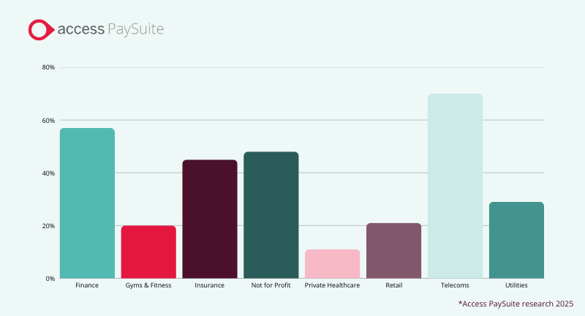
The telecoms and finance sectors have the most businesses making significant investments into AI, with private healthcare and gym and fitness businesses falling behind other industries with the lowest levels of investment.
Our survey results highlight that the finance sector has firmly established itself as the early adopter powerhouse for AI technology.
88.5% of finance organisations have already invested in AI, compared to 83% of the total sample. While 40% of all businesses surveyed said that AI is fully integrated into their processes, this jumps to 47% for the finance sector.
Why is AI investment so important?
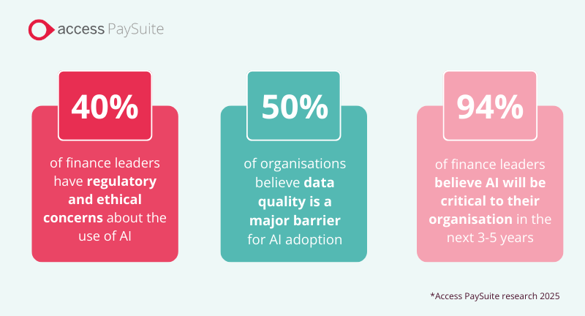
The high rate of investment in AI tools is reflected by the fact that 94% of finance leaders responding to our survey said that AI will be very important or critical to operations in their organisation over the next three to five years. Just 4% of respondents said it would not be important.
Most respondents highlighted the potential impact on operational efficiency as a primary objective of greater AI adoption in their business.
69% of finance leaders cited operational efficiency as a key drive of change, followed by cost savings (64%), wider digital transformation projects (64%) and improved end user experience (60%).
What are the key challenges businesses face in AI investment?
Despite high adoption rates, there are still some significant hurdles for private sector businesses to navigate in AI adoption.
Data quality is a major barrier for AI adoption. 46% of businesses reported this as their major obstacle, and that rises to 50% for the finance sector.
Perhaps unsurprisingly for finance-decision makers, regulatory and ethical concerns were highlighted by 40% of respondents. With the importance of data integrity to successful AI-execution, as well as strict financial regulations, there’s a clear requirement for compliance-first, FCA-authorised solutions to help businesses navigate these challenges.
What is the ‘adoption paradox’?
One of the most interesting findings from the survey was the disconnect between perceived readiness and actual preparedness.
92% of businesses reported to be ‘prepared’ to implement AI, but just 27% described themselves as ‘fully prepared’.
Almost 40% of businesses cited internal expertise as a key barrier to adoption so this suggests that while many decision-makers within businesses are bought-in to the power of AI, they lack the internal expertise and infrastructure to execute it effectively at this stage.
What do these findings mean for finance leaders?
Our survey results demonstrate clearly that AI is no longer a nice to have for finance decision makers. It is quickly becoming a core requirement for businesses to stay competitive and compliant. While the finance sector is powering ahead as an early adopter, many more businesses are either already maximising their operational efficiencies with AI, or preparing to in the near future.
As more businesses move past the exploration phase of AI adoption and embrace deep integration, this will be a catalyst for more businesses to increase their investment.
Want to find out more about our AI payment options? Reach out to a member of our team.
FAQs
How are private sector businesses using AI in payments?
Private sector businesses are leveraging AI to improve operational efficiency, enhance security, and deliver more personalized customer experiences. AI is being integrated into payment processes to automate tasks, reduce errors, and optimize workflows.
What percentage of businesses have invested in AI?
According to Access PaySuite’s survey, 83% of private sector businesses have already invested in AI. Nearly half (45%) have a fully integrated AI strategy, while others are running pilots or planning future investments.
Which industries are leading in AI adoption?
The finance and telecom sectors are leading the way in AI adoption, with finance organizations showing the highest integration rates. Private healthcare and fitness sectors are lagging behind.
Why is AI investment important for finance leaders?
AI is critical for improving operational efficiency, reducing costs, supporting digital transformation, and enhancing customer experience. 94% of finance leaders believe AI will be very important or critical to their operations within the next 3–5 years.
What challenges do businesses face when adopting AI?
Key challenges include data quality issues, regulatory and ethical concerns, and a lack of internal expertise. Compliance-first solutions and strong data governance are essential for successful AI implementation.
What is the AI adoption paradox?
While 92% of businesses claim they are prepared for AI, only 27% consider themselves fully prepared. Many lack the internal expertise and infrastructure needed for effective AI execution.