


Key Takeaways
Direct Debit Indemnity Claims (DDIC) are immediate customer refunds initiated under the Direct Debit Guarantee when a payment is taken in error. These claims are disruptive and impact a business's cash flow. Businesses (Service Users) must respond to the Direct Debit Indemnity Claim Advice (DDICA) report within a strict 9-day window. To successfully reduce and challenge claims, a business must:
- Understand the 6 Bacs reason codes for the claim.
- Ensure clear communication of payment terms and provide mandatory advance notice to customers.
- Maintain accurate records (contracts, payment notifications) to provide supporting evidence for counter-claims.
- Implement processes to prevent 'double dip' refund fraud.
- Note that if a Bacs challenge fails, the underlying debt may still be legally pursued.
Have you ever received a sudden Direct Debit refund and wondered why? A Direct Debit indemnity claim can present an unexpected challenge for businesses that collect payments via Direct Debit. Disruptive, often costly, and difficult to predict - these claims allow customers to request a refund with little notice, and if you're not prepared, they can impact your cash flow and customer relationships.
In this article, we’ll break down what Direct Debit indemnity claims are, how the DDIC process works, when customers can request refunds, and how you can protect your organisation from unnecessary losses.
Click on the following links to jump to each section:
- What is a Direct Debit indemnity claim?
- The 6 Bacs Indemnity Claim reason codes
- Direct debit indemnity claims process
- How long do Direct Debit indemnity claims take?
- What is a Direct Debit Guarantee?
- How to reduce Direct Debit indemnity claims?
- What evidence can I provide to reduce a claim?
- Indemnity Claim FAQs
Need help with Direct Debit indemnity claims? Watch a demo on our Direct Debit management platform or contact us today.

What is a Direct Debit indemnity claim?
A Direct Debit Indemnity Claim, also known as DDIC, is the method by which a payer can reclaim their Direct Debit payment back under the Direct Debit Guarantee. Under the Direct Debit Guarantee, the bank is obliged to offer an immediate refund if a Direct Debit is taken in error or without authority. This refund is then claimed back out of the Service User’s (your) bank account.
A bank indemnity claim can be disputed by the Service User within 14 working days if they can provide evidence that the Direct Debit was legitimately taken within the framework of the Bacs Guide and Rules.
The 6 Bacs Indemnity Claim reason codes
When a bank overrides your payment, the DDICA report will contain a specific reason code. Understanding these codes helps you quickly identify whether you have a grounds for a counter-claim:
- Code 1: Amount Disputed:
The collected amount differs from what the payer was told. Occurs when a business changes a variable Direct Debit or invoice total without issuing an updated bill. - Code 2: No Advance Notice Given / Timing Disputed
Payment was collected early or without the mandatory advance warning via online payment systems. Bacs requires 10 working days' notice unless contractually agreed otherwise; collecting early triggers this code. - Code 3: DDI Disputed (No Valid Mandate)
The payer claims they never authorised the Direct Debit Instruction. Points to onboarding breakdowns, administrative errors, or unauthorised setup by a client's staff. - Code 4: Payer Signature / Authority Void
A previously valid mandate has expired, changed, or been voided. Triggers when a corporate client formally cancels a mandate via their bank, but the merchant's CRM/billing software attempts to collect anyway. - Code 5: Account Holder Deceased
The account holder has passed away, freezing the mandate. Relevant in B2B when dealing with sole traders, small partnerships, or single-director businesses where banking is tied to an individual. - Code 6: Customer Cancelled Direct Debit
Disputes relating to recurring subscription billing or multi channel payments. The payer cancelled the mandate directly with their bank, but the payment still slipped through. A timing clash where a client cancels their instruction just as a payment is mid-flight in the Bacs processing cycle.
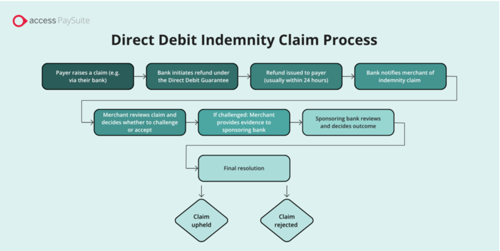
Direct debit indemnity claims process
Understanding the Direct Debit indemnity claim process can help businesses respond more effectively to disputes and reduce the risk of unnecessary chargebacks. Read on to learn about each stage of the DDIC process.
The customer notices an issue with a Direct Debit
The Direct Debit indemnity claim process usually begins when a customer identifies a problem with a payment. This could include an incorrect amount, a payment taken on the wrong date, a duplicate collection, or a payment taken after cancellation.
The customer contacts their bank
The payer then contacts their bank to raise a claim under the Direct Debit Guarantee. The bank will review the request and assess whether the payment was taken incorrectly or without authorisation.
The bank investigates the indemnity claim
The paying bank investigates the claim to determine whether it is legitimate. In many cases, customers may receive an immediate refund while the investigation takes place.
The customer receives a refund
If the claim is considered valid, the bank will refund the customer for the disputed Direct Debit payment under the Direct Debit Guarantee.
A DDICA report is raised against the business
Once the refund has been issued, the bank raises a Direct Debit Indemnity Claim Advice (DDICA) report against the service user (the business collecting the payment). The business may then need to reconcile the payment or dispute the claim with supporting evidence.
The business reconciles or disputes the claim
Once a DDICA report has been raised, the business must reconcile the payment and decide whether to dispute the claim. Supporting evidence such as contracts, payment notifications, and customer communications may be required to challenge the indemnity claim successfully.
At Access PaySuite, we can help take out the legwork and do this whole process for you with our payment solutions. Get in touch with us today to see how we can help you with all your payments.
Indemnity claims can be disruptive, but with the right reconciliation processes in place, businesses can minimise their exposure and maintain customer trust.
Beware of ‘double dip’ refund fraud
A major operational risk for subscription and utility businesses is the "double dip." This happens when a customer contacts your customer service team demanding a refund, receives it via bank transfer or card, and then immediately logs into their mobile banking app to claim a Direct Debit Indemnity for the exact same transaction.
Never issue an ad-hoc manual refund to an unhappy customer without checking your payment gateway to ensure a DDICA hasn't already been generated. If a customer insists on a refund, ensure they sign a digital waiver or wait for the standard Bacs clearing cycle to guarantee they cannot claim a second automatic refund through their bank.

How long do Direct Debit indemnity claims take?
Direct Debit indemnity claims are usually collected within 14 days. Once a claim has been raised, the service user (the business collecting the payment) has 9 days in which to dispute the claim and provide supporting evidence.
If, after 14 days, the paying bank has not heard from the service user, or if a claim challenge has been unsuccessful, it will reclaim the amount refunded to the payer from the service user. Because of these short deadlines, businesses need to keep accurate payment records and customer communications readily available.
Can I recall a direct debit?
A payer can request a Direct Debit recall, but this differs from an Indemnity Claim. A recall request must be made before the payment is processed, whereas a Direct Debit indemnity claim happens after the payment has already been collected and refunded under the Direct Debit Guarantee.
What is a Direct Debit Guarantee?
The Direct Debit Guarantee is a consumer protection measure designed to provide reassurance when paying by Direct Debit. It ensures customers can request a refund if a Direct Debit payment is taken incorrectly or without authorisation.
Under the Direct Debit Guarantee, customers can request a refund for payments taken:
- for the wrong amount
- on the wrong date
- after a Direct Debit has been cancelled
- without permission
- as a duplicate payment
In many cases, customers may receive an immediate refund from their bank while the claim is investigated. For businesses, keeping accurate customer authorisations, advance notices, and payment records can help reduce the risk of disputes and invalid indemnity claims.
Browse our guide on What is the Direct Debit Guarantee? to find out more.
Want to see how our Direct Debit platform works?
Watch the demo

How to reduce Direct Debit Indemnity Claims
While Direct Debit indemnity claims cannot always be avoided, there are several steps businesses can take to reduce disputes. Read on to learn how to reduce indemnity claims for direct debits.
1. Make sure your customers understand payment terms
You can avoid Indemnity claims by ensuring your customers are clear on when they will be charged for your services. Customers should always understand when payments will be collected, how much they will be charged, and what will appear on their bank statement.
Make sure your recurring payments remain at the same time and for an agreed value to avoid any disputes.
2. Challenge invalid indemnity claims
You can challenge a direct debit indemnity claim received from a paying PSP before the settlement of a claim or by raising a counterclaim after the refund has been issued. Sometimes you will be required to provide evidence before the refund is issued.
Indemnity Claim Rules changed back in 2017 to allow greater scope for Service Users to challenge or counter-claim indemnity claims. A key addition was that the payer who was disputing having been given authority, previously, could only be challenged if the Service User had a signed mandate as proof of authority being given.
Now, businesses may also be able to Counter Claim if there is evidence of a contract either signed by the payer, or where the payer does not dispute the existence of the contract, referring to payment by Direct Debit.
3. Understand the Bacs rules and timelines
Learn the Direct Debit rules and guidelines as outlined by Bacs, the UK’s automated payment network, regarding supporting evidence, should you need to challenge or counter an indemnity claim. As businesses only have 9 days to dispute a claim as a service provider, it's important to be prepared. A customer is well within their rights to raise an indemnity under the Direct Debit Guarantee, so making sure you are following the rules can help to reduce any future claims.
4. Make it easy for customers to contact you
Customers are more likely to raise disputes with their bank if they cannot quickly contact your business for support. Make sure all your contact details are easily found online and are included in customer communications to help resolve issues before they escalate into indemnity claims.
5. Avoid duplicate refunds
From time to time, there might be a situation where your business provides a refund directly to the customer while the customer also requests a refund from their bank, which can raise an indemnity claim. Make sure you communicate with customers to ensure they understand the refund process to reduce duplicate refunds.
Clear communication and accurate payment schedules are your first line of defence against unnecessary indemnity claims.
What evidence can I provide to counter a claim?
It'll make your life a whole lot easier if you have accurate records of all correspondence with your customers. Call recordings, emails, and contracts are all kept online in a CRM or income management system to make it easy to check if a dispute arises.
Useful evidence may include:
- A signed contract by the payer, which references payment by Direct Debit.
- Advanced notice communications showing the collection date, payment amount, and schedule.
- Customer emails or written correspondence
- Call recordings or customer service notes
- Proof of cancellation terms or payment authorisation

When to Use Small Claims vs. Bacs Counter-Claims
If you miss the 9-day dispute window, or if the paying bank rejects your counter-claim evidence, the Bacs process is officially closed. However, many businesses do not realise that a successful indemnity claim does not legally erase the underlying debt.
If your contract is valid and the services or goods were fully delivered, the customer still owes your business money. In scenarios where a customer flagrantly abuses the Direct Debit Guarantee to get free services, your finance team has the full legal right to pursue the unpaid funds via traditional debt collection agencies or the UK Small Claims Court. The bank's decision to refund a customer is a banking administration decision, not a legal ruling on the validity of your contract.
Benefits of automating your payments
Automating your payments can help businesses save time, improve cash flow, and reduce the administrative burden that comes with managing recurring payments manually- helping to create smoother Direct Debit processes.
Improve the customer experience
Offering flexible, automated online payment options makes it easier for customers to pay on time and manage their payments confidently. Payments backed by the Direct Debit Guarantee can also help build trust and reassurance.
Reduce manual admin and save time
Automating recurring payments reduces the need for manual processing, payment chasing, and reconciliation tasks. This allows teams to spend less time on admin and more time focusing on business growth.
Strengthen payment security
Using a secure, FCA-approved payment provider helps protect customer payment data and gives businesses greater confidence when managing recurring transactions.
Improve cash flow visibility
Direct Debit helps businesses create more predictable recurring revenue, making it easier to forecast income and manage cash flow challenges more effectively.

Protect your revenue from unexpected indemnity claims with Access PaySuite
Speak to our payments specialists today and discover how Access PaySuite can help you reduce risk, respond faster, and stay in control of your Direct Debit processes.
What is a Direct Debit indemnity claim?
A Direct Debit indemnity claim is a request made by a customer to their bank to refund a Direct Debit payment under the Direct Debit Guarantee. The bank is obliged to offer an immediate refund if a Direct Debit has been taken in error or without authority. This refund is then claimed back out of the Service User’s (your) bank account.
How long do Direct Debit indemnity claims take?
Most Direct Debit indemnity claims are usually processed within 14 days. Once raised, the service user has 9 working days to dispute the claim with supporting evidence. If no successful challenge is made within this timeframe, the refunded amount will be debited back from the business account.
How far back can a customer make a claim?
Under the Direct Debit Guarantee, there is no strict time limit on when a customer can raise an indemnity claim. This means customers may be able to dispute eligible payments at any point after they have been taken, even if the transaction happened some time ago.
Do indemnity claims affect a customer's credit rating?
No, a Direct Debit indemnity claim does not impact a customer’s credit score or credit file. It is a bank-managed refund process under the Direct Debit Guarantee and is not recorded as a form of credit default or borrowing behaviour.
What about recurring card payments?
A recurring card payment is where a customer gives a company their debit or credit card details so that they can take regular payments from you. Make sure your customers understand a regular payment will be taken from their account to avoid any claims later.
Learn more about recurring payments.
What is a Bacs payment?
A Bacs payment is an electronic bank-to-bank transfer used in the UK for processing Direct Debits and Direct Credits. It is the core payment system that enables Direct Debit transactions to be collected and settled between banks securely and efficiently.
Why is it important to keep your BACS contact details up to date?
Keeping your contact details up to date with Bacs ensures your business can be reached quickly if an indemnity claim is raised. Banks may need to contact you to request information or supporting evidence during a dispute, and delays can affect your ability to respond within the required timeframes.
Can I recall a Direct Debit?
No, a Direct Debit recall differs from an Indemnity Claim. A Direct Debit recall can only happen before the payment is taken, whereas an indemnity claim happens after the transaction is completed. Once a payment has been collected, any dispute must be handled through the indemnity claim process under the Direct Debit Guarantee.